Monday, 16 October 2017

Father

My father has been dead for more than a decade now so I really should have got around to sorting out his possessions a long time ago. I initially put off the inevitable emotional strain for my mother’s sake, but I had no excuse any longer - had no excuse for almost eight years, in fact. She was long gone as well, but the boxes of belongings were still there, stacked away in my attic so that I could pretend I had forgotten them, although I never could.  I adored my father with an intensity I can not describe. He was my hero for as long as I could remember and I was always Daddy’s Girl. It was his influences that formed the person I am today; his interests and hobbies that take up my time now; his values that shape my current view of the world. I remember my childhood as an idyllic time that seemed surrounded by happiness and love. There was a warmth in our home that, for me at least, emanated from my father and permeated everything around me.

A talented and creative man, my father was forced to endure a tedious job in order to provide for his family; mother, my elder brother and me. He worked long and strange hours and showed signs of the stress that caused throughout his life. Employment ate into his nights and weekends and meant that he was often trying to sleep when other folk were wide awake but, when he had free time and I was not at school, he dedicated himself to me and was always there to offer advice, help with homework or just have fun.  He compensated for the strain of his job by giving free rein to his artistic side and our home was full of paintings and sketches that he produced. To my young eyes they were priceless works of art but he would never agree. He denied his talent and claimed that his pictures were nothing more than daubs or messes. But he continued to paint because it brought him pleasure, and he owned all kinds of art materials that he was more than willing to share with me.

When Dad died, unexpectedly of a heart attack at the relatively young age of 73, I packed batches of his belongings into crates and took them away from my parents’ home so that Mother would not need to go through them herself. I had watched her attempting to sort through his clothes, lifting each item to her face and breathing in deeply, as if she could bring him back simply by remembering his smell; dabbing at her tears with the fabric of his shirts but failing to revive him or conjure him to reality. All the time her eyes were glazed and focussed in the distance, as if she could see him there, walking away from her, and she could never catch up with him. I knew I could not leave her with the task of sorting his possessions because it would never be completed, and she would never begin to recover from her sudden and terrible loss.

It was sudden and terrible for us all, of course, but her obvious devastation forced us to put our own sorrow to one side while we comforted her. It was what Dad would have wanted; how he laid down the rules. Mother always came first. She was always right, even when we knew she was wrong. Beyond my pain was the sound of his voice telling me to look after her, to make sure she was cared for and that someone stepped in to carry the responsibility he had left behind. My brother made it clear that he felt I should be the one to take care of Mother. It needed a woman’s touch, he said, and he was no good with emotional challenges. And beside that, he had never had the same kind of relationship with Dad that I had. He was eight years older than me and had been sent off to boarding school before I was born; an expense I never fully understood but Mother would only say that it was better for boys to have private schooling and that it would help [brother] to grow up stronger and more independent. So he offered to help with any paperwork or legal questions but retreated from any task that required empathy. 

So I packed up the boxes and I fought back the tears that welled up as I handled the items Dad had used. I ignored the knowledge that the last hands to touch them were his, and that those same hands would never touch anything again. My wonderful, gentle father was dead and he would never create more art. He would never hold a paint brush or a pencil. The sketchpads would remain unfilled and the paints would harden in their tubes because he was not there to work his magic on them.  But I could not allow myself to think of that as I placed his goods into boxes and sealed them up, ostensibly to be sorted at my home but, in reality, to be stored until I was strong enough to go through them with some detachment. Ten years later I had still not had the courage to open the boxes and dispose of anything. I had never felt dispassionate enough to make decisions about what to keep and what to give away. I knew that there were some perishable materials that would need to be thrown out, but I never felt able to face it, never believed I would be capable of such an act of finality. While the packing crates were there, so was a part of Dad, and I was less than willing to say goodbye. So they had remained in my attic, gathering dust and preserving the last remnants of a life that I wished could be brought back.


But now I am moving house – downsizing as the estate agents call it – and I have been forced to face up to my reluctance. I have been surprised by the strength of my aversion to opening the boxes.  Even after 10 years it is not something I want to do. I know that the objects I find in them will bring back memories and, although I believe most of them will be happy ones, I still feel the loss of my father on a daily basis and I do not want to do anything to intensify that. I have managed to bring everything down from the attic and the boxes are arranged in a small group in my lounge. I keep telling myself that I should make a start, and that I have to deal with them in order to make space in my new home. I have even tried convincing myself that I might find treasure, valuable items I could sell to help pay for my move. But my subconscious mind knows that there is nothing of intrinsic value, but the boxes are full of priceless memories of a wonderful man.

************************
Some years ago I attempted to write a novel.  This was the introduction.  

Friday, 21 July 2017

Prompt 25

As it explains - this was created in response to a writing prompt.

So I decided to spruce up my write life by looking for some prompts online and I came across a list of 25 on Pinterest. Seemed like a good number to start with; I mean there were some lists with fifty or a hundred on but I didn't want to commit to that many.

I've never been the best at following orders and going with the herd so I figured accepting someone else's prompts was a big enough sop to normality and started reading the list from the bottom. Serves me right. The suggestion was: "Write about the first thing that happened yesterday morning."

Oh come on!  I can't even remember what I had for lunch let alone first thing yesterday morning. So I need to think.  It was Tuesday. Nothing specially different about that, except I go swimming, and I go early, but not first thing.

I expect I woke up in bed. That would be a usual Tuesday. I also suspect I didn't like it when the alarm went off. It's a work day, so I assume the alarm went off. But was I already awake?  Can't remember. We have cats, you see, and (don't squirm) we let them wander in and out of the bedroom as they like, so sometimes I wake up early to a demanding meowl that means that one of them is hungry. Or a sweet little chirrup that means the other one is asleep on my pillow and is warning me not to roll over onto her. But whether Tuesday was like that escapes me.

We must have had breakfast, but that wasn't first thing either. I shower before I eat, and dress, and do my hair and other ablutions that I probably shouldn't describe. And clean my teeth. Don't get me started on the clean before or after breakfast argument. I've had it before. With a dentist. There is no easy outcome. Back away from the health advice.

So have I established anything by writing this? Well, I am still capable of responding in the written word to a prompt that I wasn't expecting. I can still waffle on for a few hundred words even if I know nothing about the topic. I'm not promising it'll be interesting though.


Friday, 5 August 2016

The Winter Ghosts

There's no doubt that Kate Mosse can spin a good yarn. Labyrinth and Sepulchre were two of my favourite recent reads, so I was delighted to spot The Winter Ghosts in my local library. (Even though it's August!) I didn't read the jacket blurb, trusting to past experience that I would enjoy the book, so I was slightly disappointed to realise from page one that it's set in exactly the same area as the previous novels.

The set-up is different. Freddie Watson has been sent to the South of France in 1933, to recuperate after a serious illness. He's still obsessed with the death of his elder brother George on the eve of the Battle of the Somme. It soon becomes clear that Freddie is sick in mind as well as body.

In a foolhardy attempt to make his way through the Pyrenees in an unreliable car he almost veers off the road and has to find help in an isolated village with a strange atmosphere. The locals make him welcome, and even invite him to a local festival, where he meets a beautiful woman called Fabrissa. As the evening passes and the wine flows he finds himself talking about his fears and loss for the first time. She tells him a tale of how her family had suffered at the hands of soldiers and the pair talk all night.

The morning after, quite predictably I'm afraid, Freddie's back at the boarding house and nobody has any memory of his being at the fete. No-one has heard of Fabrissa or any of the other people he met at the party. His coat still hangs on the hall stand and his boots are not even wet, in spite of the winter snow.

By that time it's clear to the reader that Fabrissa is one of the Winter Ghosts of the title and yes, fancy that, she probably wasn't talking about the same war that triggered Freddie's mental health problems.  I won't spoil the tale for anyone who plans to read it, but if you've read Kate Mosse's other works you'll have worked out for yourself who Fabrissa is.

Confession time - I knew nothing of the relevant period of history before I read Labyrinth, and I learned a lot from it and Sepulchre, but The Winter Ghosts is really a book too far. Time for a new research topic Ms Mosse. You write excellent and engaging prose. Your books truly are gripping, page turners, but it would have been possible to tell the same tale in reference to a different era. Man's inhumanity to man is not limited to 14th century France.

The original version of The Winter Ghosts was published as The Cave in 2009, as part of the Quick Reads initiative, aimed at young adults. Its length and simplicity show through in the later book. If you're already familiar with Mosse's work you know what to expect. If you haven't read Labyrinth and Sepulchre this might be a good place to start, then move on to the meatier works to find out more about the topic.

Monday, 27 June 2016

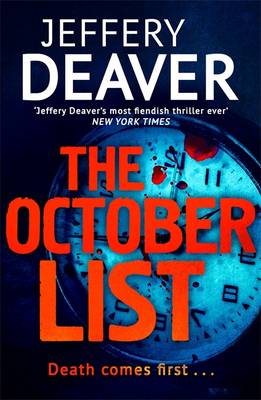
The October List

Writing a novel backwards can't be easy, and reading one that's been written backwards wasn't a stroll in the park either. Well done Jeffery Deaver for attempting to do it. It all turned out well in the end (or should that be 'at the beginning'?) but please don't do it again.

To explain, The October List starts (at chapter 36) with a kidnapper arriving at an apartment and pointing a gun at the mother of the kidnappee, and a guy who's there to keep her company. In the next chapter (35) two other guys set off to negotiate with the kidnapper for the child's safe return. In the chapter after that (34) four people arrive at the apartment to await the kidnapper's instructions. Then after that... Well, you get the idea.

It wasn't easy to follow.  And when I got to the end (chapter 1) I had to go back to 36 to check out exactly what had happened all the way back then.

Part way through I was convinced I knew what was going to happen (had happened but I hadn't read yet) and to a point I was right. I didn't guess it all. I should have known with Deaver that he still had a few twists in the plot. It was a good story. But I'd been so preoccupied trying to make sense of the backwards timeline that I didn't really enjoy it. Which is a shame.

If you're a Jeffery Deaver fan by all means give it a go. You'll stick with him because you know he'll spin a good yarn eventually. But if you aren't familiar with his work, don't start here. It will put you off reading any of his other excellent books.

Monday, 22 February 2016

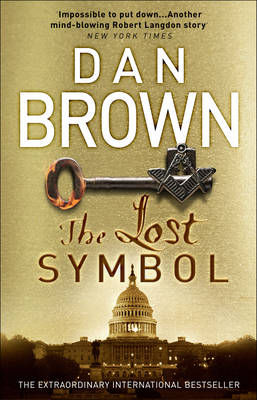
Review: The Lost Symbol - Dan Brown

Confession up front: Dan Brown isn't my favourite author. I've read The Da Vinci Code, preferred Angels and Demons, so I thought The Lost Symbol would be an easy read with a bit of entertaining hokum. That's what it offered, peppered as usual with Brown's passion for symbols and determination to link conspiracy theories and ancient folklore with a modern day challenge.

This time he's centred on Washington DC and the myriad myths connecting the foundation of the United States with the Masonic Movement. I'm not American, so maybe my lack of enthusiasm for the topic can be explained that way. Yes, it was interesting to Google pictures of the Capitol building, the Washington Monument and even a dollar bill, to see the so-called 'clues' that Brown laid out for our consumption, but somehow it just didn't grab me. I was slightly startled when the 'hand of the mysteries' symbol that starts the trail turned up on an 18th century statue at Newstead Abbey during a completely unconnected visit, but a book so definitively about the US shouldn't have delivered its biggest shock in the Nottinghamshire garden of Lord Byron.

And then there's the book's big plot twist. There's a fact that's obviously supposed to shock the reader when it's finally revealed. It certainly shocks the characters when it turns up in the narrative on page 588. Sadly, I'd worked it out at about page 260, and all it did was emphasise how clumsily Brown wrote the text to avoid mentioning it earlier.

If you like Dan Brown novels you've probably already read this. If you live in Washington DC it'll be fun to visit the buildings that feature in the story and look for the various symbols. Otherwise I can't think of a real reason to read it. At 670 pages it's about twice as long as it should be.

Tuesday, 9 February 2016

Something from 2011 I think

Being fat is not a crime. It's an eating disorder. Yet anyone who's seen as even slightly wider than a moss-covered stick is considered out of control, stupid and a fair target for insults and abuse.

It's still acceptable to say the word 'fat' as an insult, even when people aren't. I've seen plenty of examples recently. I'm increasingly convinced that those who choose to use it are lazy and lacking in imagination because all the other words they might have hurled in the past have been branded politically incorrect.

Call someone by the N word or insult their religion or sexual preferences and the world will condemn you. Call someone fat and everyone laughs. Why?

Let's look at the recent publicity over Amy Winehouse. Poor Amy. She couldn't help herself. The stress of fame and fortune got to her and she started taking drugs and drink so she could cope.
Good job she wasn't a comfort eater then, wasn't it? Otherwise the millions who have been rushing round to offer their sympathies since her death would be calling her a fat bitch.

More than half of the UK's under 30s have considered surgery to 'correct' their bodies.  Most of them think they're fat - even at size 12 (US size 8). Why?

Because it is still acceptable to use the word fat as an insult. It's about the worst thing you can say to someone these days without risking admonition.

If someone in the UK is identified as having one of the 'skinny' eating disorders such as anorexia or bulimia the might of the health service turns out to help. Full on psych support, daily guidance, the works. But until recently a fat person was told to eat less, take more exercise and go away. Being fat only increases your risk of other diseases and so you're costing the country money you fat waster.

Stuffing your fingers down your throat, taking overdoses of laxatives, smoking, drinking, popping pills, pushing white powder up your nose, etc. etc. are seen somehow as 'proper' signs of addiction that deserve help. Being addicted to eating is a sign of weakness.

Make no mistake here. Fat people do not enjoy being fat. Most of them don't even enjoy eating. They are addicted to the short-term comfort food offers. And unlike most addictions they have to learn to control it. They can't just go cold turkey.

Telling a fat person to cut down on their food is like suggesting to an alcoholic that they restrict themselves to three measures of whisky a day. It ain't gonna happen!

Everyone (except a lucky few) is addicted to something. Sex, exercise, gambling, smoking, biting fingernails, Facebook, blogging, whatever.

Next time you think about using 'fat' as an insult just consider what your own addiction is - and use that word instead.

Shoppers!

Friday, 29 January 2016

Time slip

Ben Elton is perhaps best known as a comedian, but there are not many laughs in his novel Time and Time Again. It does raise a few wry smiles, but it's far more thoughtful than mirthful. It starts with an interesting premise: suppose you could go back in time to change one thing - what would it be?  I have no idea whether Ben Elton's version of Newtonian physics that explains the time shift is even vaguely possible, but it's a challenging idea. Before you start working your way through all of history to pick your moment, let me warn you - for purposes of the storyline, you're limited to arriving in 1914. Does that give you a clue?

The tale centres on Hugh Stanton, a former soldier who has no personal ties since the loss of his wife and children in a motor accident. A bunch of  Cambridge university professors persuade him to travel back to the months before World War One and charge him with a mission. He has to prevent the assassination of the Archduke Franz Ferdinand in Sarajevo - the event generally accepted as the cause of the war - and so save millions of lives that would otherwise be lost in the conflict. But it soon becomes obvious that the academics' theory fails to take account of history's power.

Stanton arrives in the early twentieth century with good intentions, but quickly paves a path to hell as it becomes obvious that he must take several innocent lives in order to carry out his instructions. In fact the bodies fall fast at Stanton's hands and the butterfly effect of his killing begins to change history much earlier than the Cambridge Dons had planned.

Stanton spends much of the book trying to put right the wrongs he has caused, with much soul searching over the moral questions raised by his meddling. It makes for fascinating reading as an adventure story unfolds, but makes the reader agonise along with Stanton over the justification for his actions. I'd recommend it.