Showing posts with label review. Show all posts

Tuesday, 17 October 2017

The Business of Dying

A writer friend once told me that all the best stories start with a great "what if?" and that might explain what makes The Business of Dying such a gripping read. It begins with one of the best "what if?" assumptions I have ever encountered. What if a mid ranking police officer became so disillusioned with his job that he decided to moonlight as a professional hitman? It's a thrilling place to start a book because within a few pages three men have been murdered in a gangland style killing and the reader does not discover that the gunman is actually Detective Sergeant Dennis Milne until a roadblock forces him to use his warrant card to escape. (Unless you read the jacket blurb, of course.)

It soon becomes obvious that he has been set up, however, when news reports show that the dead men were customs officers, rather than the drug dealers he thought he had assassinated. In spite of his part-time occupation Milne is not a bad man. He joined the force to help remove some baddies from the world. He took up shooting them only after it became clear that modern policing was unlikely to have any long term effect on crime rates or to apprehend the real offenders. There is some interesting and thought provoking discussion on how he justifies his double life and readers are left wondering whether, in the same circumstances, they might not be driven to doing the same thing.

Given that Milne is a senior detective it is no surprise that bodies arrive thick and fast in this tale, and not all as a result of his handiwork. There is enough police procedure to satisfy the amateur sleuths who want to work out for themselves whodunnit but this is not a polished forensic drama. It has none of the glib crime-fighting paraphernalia that has taken over a lot of detective fiction since the advent of CSI.  Neither are the murders quite as straightforward as many writers would have us believe. Guns jam. Victims fight back. Blood squelches. Corpses make revolting noises. The business of dying is truly messy.

The book is Simon Kernick's first, and is a much better novel than an author's debut outing usually achieves. It has been re-released on the strength of his later success with Relentless, but this one deserves to be widely read too. Milne comes across as a real guy, facing real dilemmas in a very real world. He is also lacking in many of the now clichéd world-weary copper attributes that have littered crime novels for the last decade. For example, he drinks because he enjoys it, or because he has had a bad day at work, or because he has just killed someone. We imagine we would have a glass or two for the same reasons. His habit is not a plot device, it is a genuine part of the character.   OK, so his love life is not too promising, but police work is often cited as having a high divorce rate so that is also believable. (It does mean that he is free to sleep with a suspect, however, even after she makes some startling admissions, which is a little far-fetched.)


Beyond that there is little to detract from this cracking tale with its unusual premise. It spins along at a good pace and is far from predictable along its route. Read it soon. Because life’s too short. 

The Business of Dying
Simon Kernick
2002

Friday, 5 August 2016

The Winter Ghosts

There's no doubt that Kate Mosse can spin a good yarn. Labyrinth and Sepulchre were two of my favourite recent reads, so I was delighted to spot The Winter Ghosts in my local library. (Even though it's August!) I didn't read the jacket blurb, trusting to past experience that I would enjoy the book, so I was slightly disappointed to realise from page one that it's set in exactly the same area as the previous novels.

The set-up is different. Freddie Watson has been sent to the South of France in 1933, to recuperate after a serious illness. He's still obsessed with the death of his elder brother George on the eve of the Battle of the Somme. It soon becomes clear that Freddie is sick in mind as well as body.

In a foolhardy attempt to make his way through the Pyrenees in an unreliable car he almost veers off the road and has to find help in an isolated village with a strange atmosphere. The locals make him welcome, and even invite him to a local festival, where he meets a beautiful woman called Fabrissa. As the evening passes and the wine flows he finds himself talking about his fears and loss for the first time. She tells him a tale of how her family had suffered at the hands of soldiers and the pair talk all night.

The morning after, quite predictably I'm afraid, Freddie's back at the boarding house and nobody has any memory of his being at the fete. No-one has heard of Fabrissa or any of the other people he met at the party. His coat still hangs on the hall stand and his boots are not even wet, in spite of the winter snow.

By that time it's clear to the reader that Fabrissa is one of the Winter Ghosts of the title and yes, fancy that, she probably wasn't talking about the same war that triggered Freddie's mental health problems.  I won't spoil the tale for anyone who plans to read it, but if you've read Kate Mosse's other works you'll have worked out for yourself who Fabrissa is.

Confession time - I knew nothing of the relevant period of history before I read Labyrinth, and I learned a lot from it and Sepulchre, but The Winter Ghosts is really a book too far. Time for a new research topic Ms Mosse. You write excellent and engaging prose. Your books truly are gripping, page turners, but it would have been possible to tell the same tale in reference to a different era. Man's inhumanity to man is not limited to 14th century France.

The original version of The Winter Ghosts was published as The Cave in 2009, as part of the Quick Reads initiative, aimed at young adults. Its length and simplicity show through in the later book. If you're already familiar with Mosse's work you know what to expect. If you haven't read Labyrinth and Sepulchre this might be a good place to start, then move on to the meatier works to find out more about the topic.

Monday, 27 June 2016

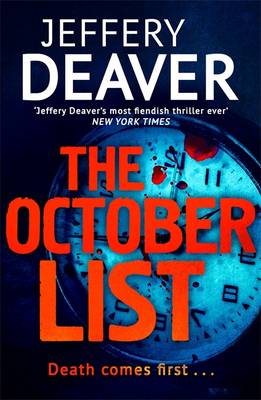
The October List

Writing a novel backwards can't be easy, and reading one that's been written backwards wasn't a stroll in the park either. Well done Jeffery Deaver for attempting to do it. It all turned out well in the end (or should that be 'at the beginning'?) but please don't do it again.

To explain, The October List starts (at chapter 36) with a kidnapper arriving at an apartment and pointing a gun at the mother of the kidnappee, and a guy who's there to keep her company. In the next chapter (35) two other guys set off to negotiate with the kidnapper for the child's safe return. In the chapter after that (34) four people arrive at the apartment to await the kidnapper's instructions. Then after that... Well, you get the idea.

It wasn't easy to follow.  And when I got to the end (chapter 1) I had to go back to 36 to check out exactly what had happened all the way back then.

Part way through I was convinced I knew what was going to happen (had happened but I hadn't read yet) and to a point I was right. I didn't guess it all. I should have known with Deaver that he still had a few twists in the plot. It was a good story. But I'd been so preoccupied trying to make sense of the backwards timeline that I didn't really enjoy it. Which is a shame.

If you're a Jeffery Deaver fan by all means give it a go. You'll stick with him because you know he'll spin a good yarn eventually. But if you aren't familiar with his work, don't start here. It will put you off reading any of his other excellent books.

Monday, 22 February 2016

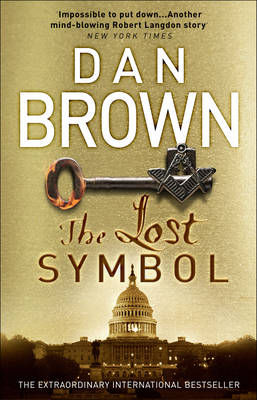
Review: The Lost Symbol - Dan Brown

Confession up front: Dan Brown isn't my favourite author. I've read The Da Vinci Code, preferred Angels and Demons, so I thought The Lost Symbol would be an easy read with a bit of entertaining hokum. That's what it offered, peppered as usual with Brown's passion for symbols and determination to link conspiracy theories and ancient folklore with a modern day challenge.

This time he's centred on Washington DC and the myriad myths connecting the foundation of the United States with the Masonic Movement. I'm not American, so maybe my lack of enthusiasm for the topic can be explained that way. Yes, it was interesting to Google pictures of the Capitol building, the Washington Monument and even a dollar bill, to see the so-called 'clues' that Brown laid out for our consumption, but somehow it just didn't grab me. I was slightly startled when the 'hand of the mysteries' symbol that starts the trail turned up on an 18th century statue at Newstead Abbey during a completely unconnected visit, but a book so definitively about the US shouldn't have delivered its biggest shock in the Nottinghamshire garden of Lord Byron.

And then there's the book's big plot twist. There's a fact that's obviously supposed to shock the reader when it's finally revealed. It certainly shocks the characters when it turns up in the narrative on page 588. Sadly, I'd worked it out at about page 260, and all it did was emphasise how clumsily Brown wrote the text to avoid mentioning it earlier.

If you like Dan Brown novels you've probably already read this. If you live in Washington DC it'll be fun to visit the buildings that feature in the story and look for the various symbols. Otherwise I can't think of a real reason to read it. At 670 pages it's about twice as long as it should be.

Friday, 29 January 2016

Time slip

Ben Elton is perhaps best known as a comedian, but there are not many laughs in his novel Time and Time Again. It does raise a few wry smiles, but it's far more thoughtful than mirthful. It starts with an interesting premise: suppose you could go back in time to change one thing - what would it be?  I have no idea whether Ben Elton's version of Newtonian physics that explains the time shift is even vaguely possible, but it's a challenging idea. Before you start working your way through all of history to pick your moment, let me warn you - for purposes of the storyline, you're limited to arriving in 1914. Does that give you a clue?

The tale centres on Hugh Stanton, a former soldier who has no personal ties since the loss of his wife and children in a motor accident. A bunch of  Cambridge university professors persuade him to travel back to the months before World War One and charge him with a mission. He has to prevent the assassination of the Archduke Franz Ferdinand in Sarajevo - the event generally accepted as the cause of the war - and so save millions of lives that would otherwise be lost in the conflict. But it soon becomes obvious that the academics' theory fails to take account of history's power.

Stanton arrives in the early twentieth century with good intentions, but quickly paves a path to hell as it becomes obvious that he must take several innocent lives in order to carry out his instructions. In fact the bodies fall fast at Stanton's hands and the butterfly effect of his killing begins to change history much earlier than the Cambridge Dons had planned.

Stanton spends much of the book trying to put right the wrongs he has caused, with much soul searching over the moral questions raised by his meddling. It makes for fascinating reading as an adventure story unfolds, but makes the reader agonise along with Stanton over the justification for his actions. I'd recommend it.

Monday, 18 January 2016

Taxidermy

Just finished reading The Taxidermist's Daughter, by Kate Mosse and it's had quite an effect on me. I've read other Mosse titles (Labyrinth & Sepulchre spring to mind) so I knew she doesn't fight shy of a bit of unpleasantness, but this still had a few shock points to deliver. I won't spoil the story for you (I don't put spoilers in reviews) so it's hard to give you a detailed summary of what it's about. It's set in 1912, though for some reason the pictures in my mind were set much earlier than that. I don't think the actual date is important really. The story would have worked over a couple of centuries, I think.

Connie Gifford lives with her father in an isolated house on the edge of a marsh in the Sussex village of Fishbourne.  He's a taxidermist, though he prefers the title "stuffer of birds". He's also a drunk. Connie can't remember her childhood, owing to an accident that her father refuses to discuss. It left her with amnesia and occasional petit mal seizures. It's clear from the start that something is odd in the village. A weird ritual goes awry when strangers turn up to watch it, and hundreds of songbirds fly out of the church when someone opens the door. Lots of the birds die, setting the tone for the remainder of the book.

A few days later a woman's body is found near Connie's house, apparently drowned, but actually having been strangled by a length of taxidermy wire. Connie is concerned for her father's state of mind, because since the ritual he has been drinking more heavily than usual. Could he be responsible for the murder? And just who can Connie trust from the village and elsewhere?

I'd like to say that I didn't work it all out before the reveal, but that's not true. About a couple of hundred pages before the end I knew 'whodunnit' and I was pretty certain why. Let's face it, writing that kind of background makes it fairly obvious that the climax of the story must be connected to Connie's accident, though the actual details were grislier than I dreamed in my mind's eye. As a writer of sorts I am perturbed when I create truly cruel or gory scenes. Let's just say I'd be really worried if I'd described what Ms Mosse delivers in this book.

Having said that, I would recommend it as a creepy mystery book. There's a bit of history included, and an awful lot of technical detail about what's involved in the craft of taxidermy. I'm not sure I'll ever be able to carve a chicken again without qualms.