Before I go much further with this I suppose I’d better explain that I’m currently posting all this onto my blog as is. I’m not editig except where I miss out a space between words (because that reduces my daily count) so it’s very, very poorly written. The sentiment is there but it’ll be full of typos and spelling erors and repetitions and all the other stuff I would normally remove before my text sees daylight. But I don’t have time on the NaNo scale to do all that. This is true stream of consciousness stuff. Beat generation eat your heart out. So onward to the next bit. If the mistakes bother you, just edit them in your mind.
If I'm going to turn this writing exercise into a NaNo project I might have to give a thought to what headings I should use to complete it. If I use these words as part of today's total it'll mean I have to edit more heavily at a later date. As if I'm ever going to try to publish my memoirs. I mean, who'd want to read them?
I suppose that depends on what I actually write about. I could probably create something to rival 50 Shades of Grey if I gave it a go, though punishment has never been my bag. But a lady doesn't kiss and tell, at least in print! So I won't be discussing my love life except when it becomes absolutely essential. (That's called a teaser. Now anyone who's reading this is going to continue in the hope of some juicy bits further down the line.)
I plan to write about my Writing Life and that means I need to discuss all the times it's been relevant. Such as:
- at primary school when I used to get top marks for my words. I could read well and write creatively and so my stories would earn praise from teachers, and sometimes even outside bodies. Cadbury (or was it Rowntree's? I forget)
- at secondary school, when my style was less than popular and I was forced into doing science that I didn't want to.
- The Sheffield year, when I learned to hone my skills and spent an evening in a bus station feeling homesick.
- The Lincoln years. Spectacular they called it and spectacular it really was.
- Durham and the great freeze. Is that a relevant chapter? I guess the Elton John episode would earn a place in teh greater story.
- Have you ever met anyone famous? Well of course I have. I was a journalist.
- Court reporting and the case of the Bald Barrister. Le Petit Prince and cups of coffee.
- Council meetings and the phantom planning report.
- Poetry. Oh yes. I write poetry too. Badly.
- Diaries.
- Blogs.
- I forgot Mr Wilson. How could I forget Mr Wilson? The way he'd read half stories or poems to us then make us write the endings. Oh Young Lochinvar is come out of the West and all that. And he were 'ung by a thread of scarlet! The Monkey's Paw.
- There's Dad, of course. I could hardly miss him out because he developed my love of books and that fuels my writing.
- I haven't got to Wellingborough yet. Although the phantom planning application was there. But there must be other things from nine years working my way up the ranks.
- The pub. Did I write at the pub? Or was that where my inspiration took its first knock? I could write about teh pub. But then I'd be off topic rather. So I probably won't. Except that was my letter writing phase. So I ought to mention Dougie and the place where Annethology first appeared.
- The post-pub years took me to University and the serious business of getting a degree. There was a lot of essay writing there. And 'let's go beat up the Iceni'.
- Sent to Coventry and the great Midlands canal survey. Learning about the gentle art of storytelling and weaving a few of my own.
- Derby and case studies. Marketing is not journalism.
There must be more. But my half hour is up and I have to go at the moment.
Can I really write 600 words in a half hour? That’s a rate of 20 a minute, or one every three seconds. So I probably can, as long as I know what I want to say. The journalist in me says of course I can, but the human being suggests I might not. And that implies that journalists are not human beigs, which they are, even if some of them are cynical hacks. I don’t think I ever became really cynical while I was a journalist. No, that was reseved for the post newspaper days when I was a pub landlady. That made me realise what a horrible bunch of slime some people can be. The liars and cheats and bullies and arrogant bastards. All life eventually passes through a bar.
No, while I was a journalist I was still driven by an innocent dream of helping the underdog. That’s why I joined up in the first place. I remember I had to write an essay about why I wanted to be a journalist before they would accept me on the training course in Sheffield. I wrote a glowing piece of prose about how the pen is mightier than the sword and I wanted to help poor embattled Joe and Josephine Public cut through the maze of red tape and officialdom. At the interview they called me a naive kid, or something along those lines, but decided that the newspaper world could handle a few more like me, and they let me in.
Of course I didn’t always want to be a journalist. I wanted to be a science writer. I saw myself as a permanent feature producer for New Scientist or Scientific American and felt I would have been good at it. My teachers, however, thought I should do science first and writing afterwards. I was shoe horned into a practical microbiology and entomology course that was no use for anything I wanted to do. Half way through I realised I was being trained to wash test tubes and would never be a proper scientist who dreamed up the research. I’d just be the over-educated charwoman who cleared away the mess and wiped the work benches down after the brains finished their work. Not for me buster! I quit cold at the end of year one and vowed never to go back.
I had no idea what I wanted to do next. My dream of being a professional writer seemed to have gone out of the window. I didn’t know how to retrieve it and looked around for just any old job to fill in the time while I thought about life, the universe and everything. (which, as far as I remember, was published round about the same time. Or at least broadcast. Maybe I need to look that fact up to be sure.)
So I spent a summer selling shoes and serving coffees and clearing tables in a nightclub and washing glasses and generally having a good time. I worked as a waitress in a local pub and met a ghost from my past who ultimately saved me from a fate worse than death but also taught me to like Scotch, so I guess that’s evens then. Scotch is a vicious drink and I know why a lot of sots people are punchy. Whisky does that to me. I’ll hit anyone if I get drunk on whisky. I even nicked a policeman’s helmet once but that’s a whole other story. On the other hand, whiskey (with an e) from the Emerald Isle is a different thing altogether. They triple distil it, so it removes some of the junk that makes the other stuff so harsh and presumably makes the scots angry. In Ireland they sip it, wth plenty of water, and sing amiably until they slide not so gracefully under the table and snore gently till morning. Some bitter Irish widows might disagree about all that, but I digress. Where was I? Oh yes, the dream of being a writer.
One morning I was most surprised to find a cutting from a newspaper on the table in the lounge. I was back living at hme, of course, and having difficulty adjusting to the fact that parents expect you to tell them where you’re going and what time you’ll be back and all that other rigmarole. I’d had a year of being my own boss so I wasn’t happy about it, but give Mother her due (not something I do often) she seemed to understand what was actually missing from my life. The press cutting was an advert for a course in journalism: 12 months of learning how to write for newspapers with a fair chance of finding a job on one at the end. I applied. Mother was deeply surprised that something she suggested had gone down so well and told me the tale of the gypsy fortune teller who said she would one day have a child who worked in the newspaper world. Mind you, the woman also told her that one day she’d live in a cottage with roses round the door but she never did. I’m not sure what else was in the tea leaves but I’ll give her the benefit of the doubt and say two out of three ain’t bad!
It was a great course. There was law and public administration which I enjoyed immensely and even considered giving up on journalism to become a solicitor, but I stuck with the Sheffield year and never really regretted it. Particularly when I found myself becoming a court reporter and writing about the law, rather than practising it. I was good at law, and even remembered enough of it years later to upset a fellow student because I could have done her case law exam and she couldn’t. I’d been a court reporter for more than a decade by then and she was on her first year of lawyer learning. And so the dream came true, albeit a long way round. Eventually I even wrote about science. But first and foremost I was a journalist and that taught me a whole raft of skills that I’ve put to good use ever since.
Thursday, 2 November 2017

Wednesday, 1 November 2017
Not NaNo November 1
There’s a thing called NaNoWriMo that I’ve taken part in over a few years. The idea is that you write 50,000 words of a novel in 30 days during November. That works out at 1,667 words a day, which is no mean feat in itself. But the big challenge is, of course, telling some sort of story. If you’re going to write a novel you need a tale somewhere in your head to weave the words around. This year I have nothing going round in my head at all. It’s not like me to have no idea of a way to entertain. I have been known in previous Nano years to start typing and hope for the best. Sometimes it works and other times it goes awry.
For instance, a few years ago I started what was supposed to be a comical tale about a magic necklace and its effects of the girl who bought it. The first few paragraphs started well and I found myself tapping the keyboard merrily and chalking up the word total without too much thought of what I was actually composing.
It must have been a couple of pages in before I realised that the story had taken a very dark turn. There was a body, for a start. The girl used a phrase I’m fond of: “Go play on a railway line”. Someone had annoyed her and she used the term lightly as her way to deal with the irritation. Much like I do. Of course, no-one I’ve said it to (or about) has ever actually done it. But her victim did. The man went off into town and followed the enchantment. The next thing I knew he was hit by a train. Bam! Dead. You don’t expect that when you set out to write a comedy.
Then there was the year I started on an epic four generation tale of a family whose members never reach their 60th birthdays. OK, I admit that wasn’t ever going to be a laugh a minute. It had a few moments of wry humour but it was short on belly laughs. All was going well. The dates all fit together and I found some interesting ways to kill off some of the family members. One died of exhaustion after giving birth to about 14 children. (Most of them died young!) One was hit by a tram in the centre of Manchester. Another died in prison after one of the other inmates took a dislike to him and shanked him with a sharpened comb. Then there was poor old George. For narrative purposes he had to be so depressed that he killed himself by drowning in the canal. I got through most of his history but found that I was hating myself for the horrible things I was doing to him to drive him mad. Incidentally, it was his wife who was hit by the tram! I couldn’t actually bring myself to finish his chapter. That book still languishes on an old laptop somewhere, missing about 17 chapters. To be fair I was a bit stumped about how I was going to get around five of the family into one place so they could all be hit by a German bombing raid.
The book was historically accurate and the bombing raid really happened. I did a lot of research into the life and times of people from the late 19th century through to the start of the 21st. It should have been a very good book, and still would be if I could bring myself to return to it. But I can’t force myself to go back and torture poor George. While I leave the text alone he isn’t dead – even though he was born in about 1920! I’ve written the last chapter, so I know how the book ends. I just have a huge chunk of nastiness missing from the middle.
The magic necklace book ad a similar effect on me. I gave up on it after I’d killed off the guy on the railway line, but I went back to that one the following year. I did eventually manage to turn it into something readable and even got a few laughs into it. I managed to upset a friend because I based one of the characters on her. She was a very large personality and clearly recognised herself in the early chapters I let her read. Big mistake. She gave up reading. So she never found out that she was the heroine of that tale. A little bit like those 1950s school-based stories where a plucky first year saves the lives of a bunch of stupid sixth formers. She started out appearing to be a bit of an air head but in the end she was keeping a deep secret that helped her to overcome the baddie. I was a bit fond of my baddie in that story. He was an enchanted member of the fae who could use glamour to confuse people. I’m not saying who he was based on, but |I’ve been divorced twice!
The good guy – or one of them – was based on somebody on TV that I thought was a bit of a looker. Anyone who reads it and knows me will be able to work it out. Who it’s based on, that is.
To be fair I have a bit of a problem with what my characters look like. I’m usually pretty good at coming up with names (when in doubt I go graveyard hunting. You can find some corking names on headstones that you’d never invent yourself!). I can dream up back stories. If you doubt that just you read my collection of short stories about the retired theatre dresser. His back story is amazing and so are the backgrounds of several of the bit-part players. So I can string along a convincing narrative but the problem is I can’t start writing until I know what the characters look like. I cannot, to save my life, dream up a face.
Back in the day I would watch TV and pick out suitable faces from the also-rans. You can’t really use big names because people recognise them. So if you need a romantic hero from the Victorian era you can’t really use one of the Doctors Who. Except maybe David Tennant because he would make an excellent Victorian romantic lead and people would forgive you. So you need “that bloke third on the left in the jury in Law and Order the other night”. But these days it’s easier to find a face for my characters. These days I go hunting online.
It’s surprisingly easy to put something like “blond good looking man early 40s” into a search engine and get a string of photos that look like an identity parade. With a bit of effort you can sometimes get a whole back story to use with the face. Some people are stupid about how much information they put online. Take this as a warning. If you ever post a selfie from your phone make sure you’ve switched off the location data. Particularly if it’s in your back garden! Otherwise you might just find yourself being stalked by a frustrated author who liked the look of your face to be a serial killer in their latest book. (Of course it could be worse. You could be stalked by a serial killer who just likes the look of your face. )
Take care on where the hunt leads you though. It’s hard to avoid that ‘put your name into Google’ moment. Resistance is futile. That’s how I found out that I run a fire service in Canada; I work for an accountant about 10 miles down the road; I’ve written at least two history text books; and I’m buried in Cambridgeshire. Scary stuff!
So what was the point in starting this exercise tonight? I don’t have a Nano novel in my brain and it’s not like I don’t spend all day at work writing these days. Why do I feel the need to write 1667 words a night to meet some self-imposed standard? I don’t NEED to write anything. But somehow I feel better when I manage to keep up the pace. And you never know, I might come up with a workable idea between now and November 30. Even if all I do is craft a few short stories along the way it’ll be more than I’ve done in a long time. I used to write regularly. I used to have ideas bursting their way through my skull. They knock on the inside of my head and demand to be put into data form. But not lately. I’m not sure where my inspiration went. In fact I wrote a poem a couple of years ago that was precisely about losing my muse. But that was inspired by a sculpture in Leicester Botanic Gardens. It was big and red and angular, I remember. The sculpture that is, not the poem.
I guess I need to have an outlet for my creativity, even if what I create is rubbish. There’s no such thing as wasted words. Any one of these sentences might be the springboard to something better. Or then again it might just languish in my laptop like previous efforts have.
It’s refreshing to know that I can keep up a stream of words until I reach 1,667 and that some people will be daft enough to read to the end. Not many, of course. The ones who love me; the ones who are curious; the ones with nothing better to do. I just wish I’d noted down my start time to see how long it takes me to get to the target. Because I’m not far off now and I know I’ve been typing for at least half an hour. Maybe longer. Now I just need 12 words to get to the end. Five, four, three, two, one. Yay!
For instance, a few years ago I started what was supposed to be a comical tale about a magic necklace and its effects of the girl who bought it. The first few paragraphs started well and I found myself tapping the keyboard merrily and chalking up the word total without too much thought of what I was actually composing.
It must have been a couple of pages in before I realised that the story had taken a very dark turn. There was a body, for a start. The girl used a phrase I’m fond of: “Go play on a railway line”. Someone had annoyed her and she used the term lightly as her way to deal with the irritation. Much like I do. Of course, no-one I’ve said it to (or about) has ever actually done it. But her victim did. The man went off into town and followed the enchantment. The next thing I knew he was hit by a train. Bam! Dead. You don’t expect that when you set out to write a comedy.
Then there was the year I started on an epic four generation tale of a family whose members never reach their 60th birthdays. OK, I admit that wasn’t ever going to be a laugh a minute. It had a few moments of wry humour but it was short on belly laughs. All was going well. The dates all fit together and I found some interesting ways to kill off some of the family members. One died of exhaustion after giving birth to about 14 children. (Most of them died young!) One was hit by a tram in the centre of Manchester. Another died in prison after one of the other inmates took a dislike to him and shanked him with a sharpened comb. Then there was poor old George. For narrative purposes he had to be so depressed that he killed himself by drowning in the canal. I got through most of his history but found that I was hating myself for the horrible things I was doing to him to drive him mad. Incidentally, it was his wife who was hit by the tram! I couldn’t actually bring myself to finish his chapter. That book still languishes on an old laptop somewhere, missing about 17 chapters. To be fair I was a bit stumped about how I was going to get around five of the family into one place so they could all be hit by a German bombing raid.
The book was historically accurate and the bombing raid really happened. I did a lot of research into the life and times of people from the late 19th century through to the start of the 21st. It should have been a very good book, and still would be if I could bring myself to return to it. But I can’t force myself to go back and torture poor George. While I leave the text alone he isn’t dead – even though he was born in about 1920! I’ve written the last chapter, so I know how the book ends. I just have a huge chunk of nastiness missing from the middle.
The magic necklace book ad a similar effect on me. I gave up on it after I’d killed off the guy on the railway line, but I went back to that one the following year. I did eventually manage to turn it into something readable and even got a few laughs into it. I managed to upset a friend because I based one of the characters on her. She was a very large personality and clearly recognised herself in the early chapters I let her read. Big mistake. She gave up reading. So she never found out that she was the heroine of that tale. A little bit like those 1950s school-based stories where a plucky first year saves the lives of a bunch of stupid sixth formers. She started out appearing to be a bit of an air head but in the end she was keeping a deep secret that helped her to overcome the baddie. I was a bit fond of my baddie in that story. He was an enchanted member of the fae who could use glamour to confuse people. I’m not saying who he was based on, but |I’ve been divorced twice!
The good guy – or one of them – was based on somebody on TV that I thought was a bit of a looker. Anyone who reads it and knows me will be able to work it out. Who it’s based on, that is.
To be fair I have a bit of a problem with what my characters look like. I’m usually pretty good at coming up with names (when in doubt I go graveyard hunting. You can find some corking names on headstones that you’d never invent yourself!). I can dream up back stories. If you doubt that just you read my collection of short stories about the retired theatre dresser. His back story is amazing and so are the backgrounds of several of the bit-part players. So I can string along a convincing narrative but the problem is I can’t start writing until I know what the characters look like. I cannot, to save my life, dream up a face.
Back in the day I would watch TV and pick out suitable faces from the also-rans. You can’t really use big names because people recognise them. So if you need a romantic hero from the Victorian era you can’t really use one of the Doctors Who. Except maybe David Tennant because he would make an excellent Victorian romantic lead and people would forgive you. So you need “that bloke third on the left in the jury in Law and Order the other night”. But these days it’s easier to find a face for my characters. These days I go hunting online.
It’s surprisingly easy to put something like “blond good looking man early 40s” into a search engine and get a string of photos that look like an identity parade. With a bit of effort you can sometimes get a whole back story to use with the face. Some people are stupid about how much information they put online. Take this as a warning. If you ever post a selfie from your phone make sure you’ve switched off the location data. Particularly if it’s in your back garden! Otherwise you might just find yourself being stalked by a frustrated author who liked the look of your face to be a serial killer in their latest book. (Of course it could be worse. You could be stalked by a serial killer who just likes the look of your face. )
Take care on where the hunt leads you though. It’s hard to avoid that ‘put your name into Google’ moment. Resistance is futile. That’s how I found out that I run a fire service in Canada; I work for an accountant about 10 miles down the road; I’ve written at least two history text books; and I’m buried in Cambridgeshire. Scary stuff!
So what was the point in starting this exercise tonight? I don’t have a Nano novel in my brain and it’s not like I don’t spend all day at work writing these days. Why do I feel the need to write 1667 words a night to meet some self-imposed standard? I don’t NEED to write anything. But somehow I feel better when I manage to keep up the pace. And you never know, I might come up with a workable idea between now and November 30. Even if all I do is craft a few short stories along the way it’ll be more than I’ve done in a long time. I used to write regularly. I used to have ideas bursting their way through my skull. They knock on the inside of my head and demand to be put into data form. But not lately. I’m not sure where my inspiration went. In fact I wrote a poem a couple of years ago that was precisely about losing my muse. But that was inspired by a sculpture in Leicester Botanic Gardens. It was big and red and angular, I remember. The sculpture that is, not the poem.
I guess I need to have an outlet for my creativity, even if what I create is rubbish. There’s no such thing as wasted words. Any one of these sentences might be the springboard to something better. Or then again it might just languish in my laptop like previous efforts have.
It’s refreshing to know that I can keep up a stream of words until I reach 1,667 and that some people will be daft enough to read to the end. Not many, of course. The ones who love me; the ones who are curious; the ones with nothing better to do. I just wish I’d noted down my start time to see how long it takes me to get to the target. Because I’m not far off now and I know I’ve been typing for at least half an hour. Maybe longer. Now I just need 12 words to get to the end. Five, four, three, two, one. Yay!
Tuesday, 17 October 2017
The Business of Dying
A
writer friend once told me that all the best stories start with a great
"what if?" and that might explain what makes The Business of Dying
such a gripping read. It begins with one of the best "what if?"
assumptions I have ever encountered. What if a mid ranking police officer
became so disillusioned with his job that he decided to moonlight as a
professional hitman? It's a thrilling place to start a book because within a
few pages three men have been murdered in a gangland style killing and the
reader does not discover that the gunman is actually Detective Sergeant Dennis
Milne until a roadblock forces him to use his warrant card to escape. (Unless
you read the jacket blurb, of course.)
It
soon becomes obvious that he has been set up, however, when news reports show
that the dead men were customs officers, rather than the drug dealers he
thought he had assassinated. In spite of his part-time occupation Milne is not
a bad man. He joined the force to help remove some baddies from the world. He
took up shooting them only after it became clear that modern policing was
unlikely to have any long term effect on crime rates or to apprehend the real
offenders. There is some interesting and thought provoking discussion on how he
justifies his double life and readers are left wondering whether, in the same
circumstances, they might not be driven to doing the same thing.
Given
that Milne is a senior detective it is no surprise that bodies arrive thick and
fast in this tale, and not all as a result of his handiwork. There is enough
police procedure to satisfy the amateur sleuths who want to work out for
themselves whodunnit but this is not
a polished forensic drama. It has none of the glib crime-fighting paraphernalia
that has taken over a lot of detective fiction since the advent of CSI. Neither are the murders quite as
straightforward as many writers would have us believe. Guns jam. Victims fight
back. Blood squelches. Corpses make revolting noises. The business of dying is truly
messy.
The
book is Simon Kernick's first, and is a much better novel than an author's
debut outing usually achieves. It has been re-released on the strength of his
later success with Relentless, but
this one deserves to be widely read too. Milne comes across as a real guy,
facing real dilemmas in a very real world. He is also lacking in many of the
now clichéd world-weary copper attributes that have littered crime novels for
the last decade. For example, he drinks because he enjoys it, or because he has
had a bad day at work, or because he has just killed someone. We imagine we
would have a glass or two for the same reasons. His habit is not a plot device,
it is a genuine part of the character. OK,
so his love life is not too promising, but police work is often cited as having
a high divorce rate so that is also believable. (It does mean that he is free
to sleep with a suspect, however, even after she makes some startling
admissions, which is a little far-fetched.)
Beyond
that there is little to detract from this cracking tale with its unusual
premise. It spins along at a good pace and is far from predictable along its
route. Read it soon. Because life’s too short.
The Business of Dying
Simon Kernick
2002
Monday, 16 October 2017
Father
My
father has been dead for more than a decade now so I really should have got
around to sorting out his possessions a long time ago. I initially put off the
inevitable emotional strain for my mother’s sake, but I had no excuse any
longer - had no excuse for almost eight years, in fact. She was long gone as
well, but the boxes of belongings were still there, stacked away in my attic so
that I could pretend I had forgotten them, although I never could. I adored my father with an intensity I can not
describe. He was my hero for as long as I could remember and I was always
Daddy’s Girl. It was his influences that formed the person I am today; his
interests and hobbies that take up my time now; his values that shape my
current view of the world. I remember my childhood as an idyllic time that
seemed surrounded by happiness and love. There was a warmth in our home that,
for me at least, emanated from my father and permeated everything around me.
A
talented and creative man, my father was forced to endure a tedious job in order
to provide for his family; mother, my elder brother and me. He worked
long and strange hours and showed signs of the stress that caused throughout
his life. Employment ate into his nights and weekends and meant that he was
often trying to sleep when other folk were wide awake but, when he had free
time and I was not at school, he dedicated himself to me and was always there
to offer advice, help with homework or just have fun. He compensated for the strain of his job by
giving free rein to his artistic side and our home was full of paintings and
sketches that he produced. To my young eyes they were priceless works of art but
he would never agree. He denied his talent and claimed that his pictures were
nothing more than daubs or messes. But he continued to paint because it brought
him pleasure, and he owned all kinds of art materials that he was more than
willing to share with me.
When
Dad died, unexpectedly of a heart attack at the relatively young age of 73, I
packed batches of his belongings into crates and took them away from my
parents’ home so that Mother would not need to go through them herself. I had
watched her attempting to sort through his clothes, lifting each item to her
face and breathing in deeply, as if she could bring him back simply by
remembering his smell; dabbing at her tears with the fabric of his shirts but
failing to revive him or conjure him to reality. All the time her eyes were
glazed and focussed in the distance, as if she could see him there, walking away
from her, and she could never catch up with him. I knew I could not leave her
with the task of sorting his possessions because it would never be completed,
and she would never begin to recover from her sudden and terrible loss.
It
was sudden and terrible for us all, of course, but her obvious devastation
forced us to put our own sorrow to one side while we comforted her. It was what
Dad would have wanted; how he laid down the rules. Mother always came first.
She was always right, even when we knew she was wrong. Beyond my pain was the
sound of his voice telling me to look after her, to make sure she was cared for
and that someone stepped in to carry the responsibility he had left behind. My
brother made it clear that he felt I should be the one to take care of Mother.
It needed a woman’s touch, he said, and he was no good with emotional
challenges. And beside that, he had never had the same kind of relationship
with Dad that I had. He was eight years older than me and had been sent off to
boarding school before I was born; an expense I never fully understood but
Mother would only say that it was better for boys to have private schooling and
that it would help [brother] to grow up stronger and more independent. So he offered
to help with any paperwork or legal questions but retreated from any task that
required empathy.
So
I packed up the boxes and I fought back the tears that welled up as I handled
the items Dad had used. I ignored the knowledge that the last hands to touch
them were his, and that those same hands would never touch anything again. My
wonderful, gentle father was dead and he would never create more art. He would
never hold a paint brush or a pencil. The sketchpads would remain unfilled and
the paints would harden in their tubes because he was not there to work his
magic on them. But I could not allow
myself to think of that as I placed his goods into boxes and sealed them up,
ostensibly to be sorted at my home but, in reality, to be stored until I was
strong enough to go through them with some detachment. Ten years later I had
still not had the courage to open the boxes and dispose of anything. I had
never felt dispassionate enough to make decisions about what to keep and what
to give away. I knew that there were some perishable materials that would need
to be thrown out, but I never felt able to face it, never believed I would be
capable of such an act of finality. While the packing crates were there, so was
a part of Dad, and I was less than willing to say goodbye. So they had remained
in my attic, gathering dust and preserving the last remnants of a life that I
wished could be brought back.
But
now I am moving house – downsizing as the estate agents call it – and I have
been forced to face up to my reluctance. I have been surprised by the strength
of my aversion to opening the boxes. Even
after 10 years it is not something I want to do. I know that the objects I find
in them will bring back memories and, although I believe most of them will be
happy ones, I still feel the loss of my father on a daily basis and I do not
want to do anything to intensify that. I have managed to bring everything down
from the attic and the boxes are arranged in a small group in my lounge. I keep
telling myself that I should make a start, and that I have to deal with them in
order to make space in my new home. I have even tried convincing myself that I
might find treasure, valuable items I could sell to help pay for my move. But
my subconscious mind knows that there is nothing of intrinsic value, but the
boxes are full of priceless memories of a wonderful man.
************************
Some years ago I attempted to write a novel. This was the introduction.
Friday, 21 July 2017
Prompt 25
As it explains - this was created in response to a writing prompt.
So I decided to spruce up my write life by looking for some prompts online and I came across a list of 25 on Pinterest. Seemed like a good number to start with; I mean there were some lists with fifty or a hundred on but I didn't want to commit to that many.
I've never been the best at following orders and going with the herd so I figured accepting someone else's prompts was a big enough sop to normality and started reading the list from the bottom. Serves me right. The suggestion was: "Write about the first thing that happened yesterday morning."
Oh come on! I can't even remember what I had for lunch let alone first thing yesterday morning. So I need to think. It was Tuesday. Nothing specially different about that, except I go swimming, and I go early, but not first thing.
I expect I woke up in bed. That would be a usual Tuesday. I also suspect I didn't like it when the alarm went off. It's a work day, so I assume the alarm went off. But was I already awake? Can't remember. We have cats, you see, and (don't squirm) we let them wander in and out of the bedroom as they like, so sometimes I wake up early to a demanding meowl that means that one of them is hungry. Or a sweet little chirrup that means the other one is asleep on my pillow and is warning me not to roll over onto her. But whether Tuesday was like that escapes me.
We must have had breakfast, but that wasn't first thing either. I shower before I eat, and dress, and do my hair and other ablutions that I probably shouldn't describe. And clean my teeth. Don't get me started on the clean before or after breakfast argument. I've had it before. With a dentist. There is no easy outcome. Back away from the health advice.
So have I established anything by writing this? Well, I am still capable of responding in the written word to a prompt that I wasn't expecting. I can still waffle on for a few hundred words even if I know nothing about the topic. I'm not promising it'll be interesting though.
So I decided to spruce up my write life by looking for some prompts online and I came across a list of 25 on Pinterest. Seemed like a good number to start with; I mean there were some lists with fifty or a hundred on but I didn't want to commit to that many.
I've never been the best at following orders and going with the herd so I figured accepting someone else's prompts was a big enough sop to normality and started reading the list from the bottom. Serves me right. The suggestion was: "Write about the first thing that happened yesterday morning."
Oh come on! I can't even remember what I had for lunch let alone first thing yesterday morning. So I need to think. It was Tuesday. Nothing specially different about that, except I go swimming, and I go early, but not first thing.
I expect I woke up in bed. That would be a usual Tuesday. I also suspect I didn't like it when the alarm went off. It's a work day, so I assume the alarm went off. But was I already awake? Can't remember. We have cats, you see, and (don't squirm) we let them wander in and out of the bedroom as they like, so sometimes I wake up early to a demanding meowl that means that one of them is hungry. Or a sweet little chirrup that means the other one is asleep on my pillow and is warning me not to roll over onto her. But whether Tuesday was like that escapes me.
We must have had breakfast, but that wasn't first thing either. I shower before I eat, and dress, and do my hair and other ablutions that I probably shouldn't describe. And clean my teeth. Don't get me started on the clean before or after breakfast argument. I've had it before. With a dentist. There is no easy outcome. Back away from the health advice.
So have I established anything by writing this? Well, I am still capable of responding in the written word to a prompt that I wasn't expecting. I can still waffle on for a few hundred words even if I know nothing about the topic. I'm not promising it'll be interesting though.
Friday, 5 August 2016
The Winter Ghosts
The set-up is different. Freddie Watson has been sent to the South of France in 1933, to recuperate after a serious illness. He's still obsessed with the death of his elder brother George on the eve of the Battle of the Somme. It soon becomes clear that Freddie is sick in mind as well as body.
In a foolhardy attempt to make his way through the Pyrenees in an unreliable car he almost veers off the road and has to find help in an isolated village with a strange atmosphere. The locals make him welcome, and even invite him to a local festival, where he meets a beautiful woman called Fabrissa. As the evening passes and the wine flows he finds himself talking about his fears and loss for the first time. She tells him a tale of how her family had suffered at the hands of soldiers and the pair talk all night.
The morning after, quite predictably I'm afraid, Freddie's back at the boarding house and nobody has any memory of his being at the fete. No-one has heard of Fabrissa or any of the other people he met at the party. His coat still hangs on the hall stand and his boots are not even wet, in spite of the winter snow.
By that time it's clear to the reader that Fabrissa is one of the Winter Ghosts of the title and yes, fancy that, she probably wasn't talking about the same war that triggered Freddie's mental health problems. I won't spoil the tale for anyone who plans to read it, but if you've read Kate Mosse's other works you'll have worked out for yourself who Fabrissa is.
Confession time - I knew nothing of the relevant period of history before I read Labyrinth, and I learned a lot from it and Sepulchre, but The Winter Ghosts is really a book too far. Time for a new research topic Ms Mosse. You write excellent and engaging prose. Your books truly are gripping, page turners, but it would have been possible to tell the same tale in reference to a different era. Man's inhumanity to man is not limited to 14th century France.
The original version of The Winter Ghosts was published as The Cave in 2009, as part of the Quick Reads initiative, aimed at young adults. Its length and simplicity show through in the later book. If you're already familiar with Mosse's work you know what to expect. If you haven't read Labyrinth and Sepulchre this might be a good place to start, then move on to the meatier works to find out more about the topic.
Monday, 27 June 2016
The October List
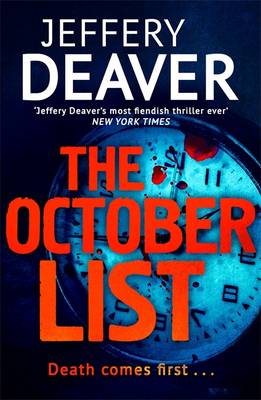
To explain, The October List starts (at chapter 36) with a kidnapper arriving at an apartment and pointing a gun at the mother of the kidnappee, and a guy who's there to keep her company. In the next chapter (35) two other guys set off to negotiate with the kidnapper for the child's safe return. In the chapter after that (34) four people arrive at the apartment to await the kidnapper's instructions. Then after that... Well, you get the idea.
It wasn't easy to follow. And when I got to the end (chapter 1) I had to go back to 36 to check out exactly what had happened all the way back then.
Part way through I was convinced I knew what was going to happen (had happened but I hadn't read yet) and to a point I was right. I didn't guess it all. I should have known with Deaver that he still had a few twists in the plot. It was a good story. But I'd been so preoccupied trying to make sense of the backwards timeline that I didn't really enjoy it. Which is a shame.
If you're a Jeffery Deaver fan by all means give it a go. You'll stick with him because you know he'll spin a good yarn eventually. But if you aren't familiar with his work, don't start here. It will put you off reading any of his other excellent books.
Subscribe to:
Posts (Atom)